Each World Cup final has its own tale. Some are remembered for their goals, others for a single tactical move that alters the game. The next Spain vs. Argentina final is one of those games where the little things can mean a lot. Spain has the best structure, but Argentina has the belief of a defending champion with Messi leading from the front. This is not only a battle between two fantastic sides but also a battle of two styles of football. As part of our Playkaro tactical preview of the final match, we will take a look at the midfield battle, formations, and hotspots.
Spain vs Argentina Tactical Preview: Where the Final Could Be Won
It is through moments that every match ends, but such moments are normally created by the side with possession of the ball in the middle of the pitch.
In Spain’s case, they have dominated possession of the ball throughout the tournament and moved it at a slow pace to frustrate their opponents. In contrast, Argentina has played in an effective manner with a proper balance between discipline and fast counters.
This contrast makes the Spain vs Argentina tactical preview particularly interesting. Spain will attempt to set the pace with extended periods of possession, while Argentina will seek to play direct attacks with Lionel Messi and Julián Álvarez when they regain possession.
The team that manages to establish its own tempo will make a big leap towards winning the trophy.
Midfield Control Could Decide Everything
The games like this are not won only with individual brilliance
Rather, the midfield winner typically dominates the game.
Spain’s Midfield Control Configurations
The midfield has been one of the most potent at the FIFA World Cup 2026.
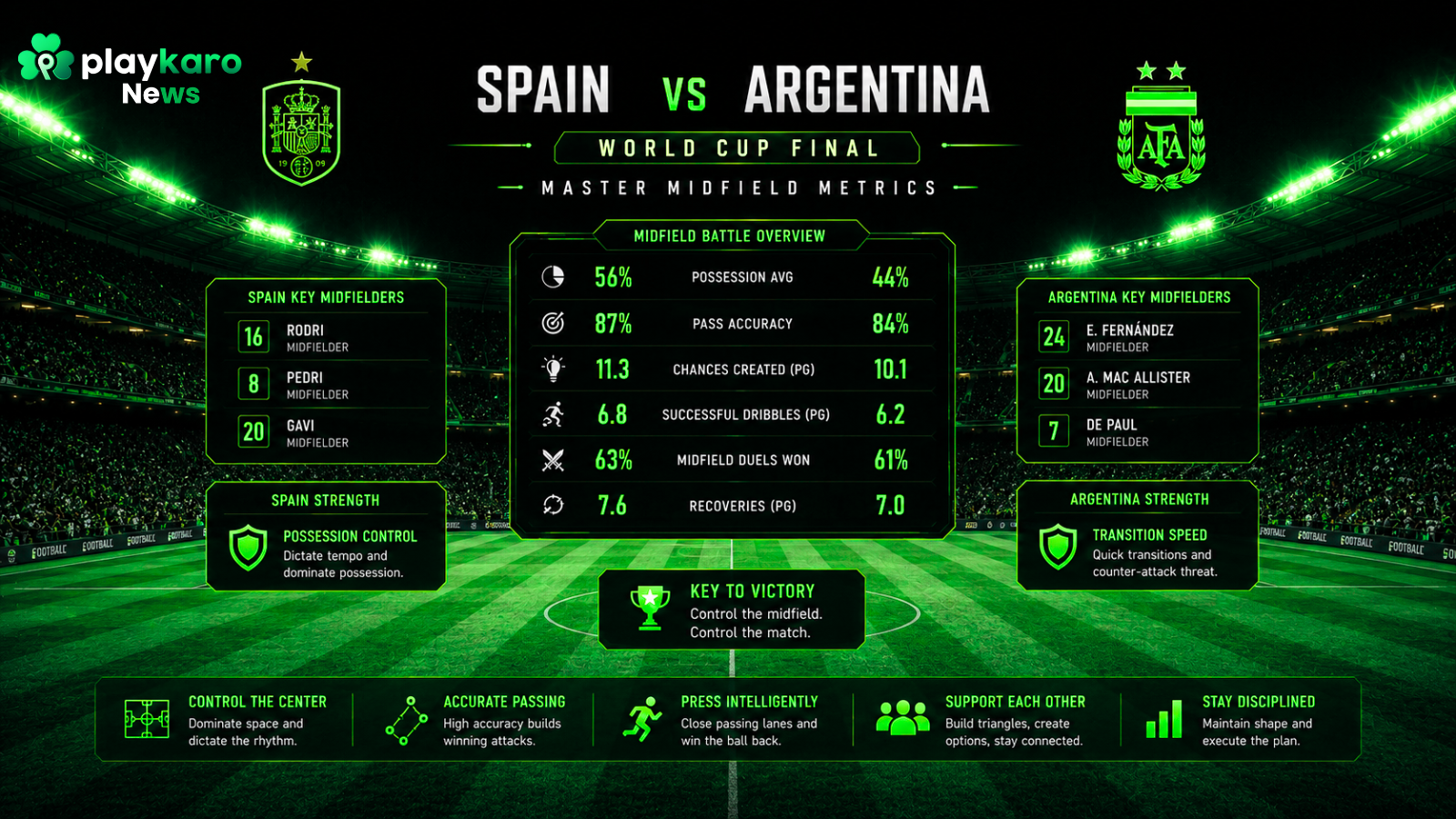
Rodri remains as a defensive anchor, while Pedri and Fabián Ruiz are useful in carrying the ball into attacking positions without the ball being lost. Their knowledge enables Spain to play the game at a more relaxed pace when necessary and to launch attacks at the right time.
Spain has conceded very few chances throughout the tournament with these midfield control set-ups.
Argentina’s Experience in Central Areas
Argentina plays midfield differently.
They don’t keep ball possession for too long. They play in a duel manner and make room for Messi to shoot.
Enzo Fernández and Rodrigo De Paul are the energy men, while Alexis Mac Allister connects midfield to the forwards. They are quick to recover possession, giving Argentina the chance to launch dangerous counterattacks.
One of the greatest assets of Lionel Scaloni’s team has been this balance all season.
The Battle That Fans Should Watch
Rodri’s duel with Argentina’s midfield trio could be more significant than any one of the goalscoring threats.
Spain can tire Argentina out if they have the ball.
Argentina could make the game much more open than anticipated if they break Spain’s rhythm early.
Defensive Structure Calibration Will Be Under Pressure
Both teams have made it to the final by merit.
The defensive structure calibration has been different in Argentina.
Instead of sitting deep, they defend aggressively in midfield before quickly transitioning into attack. This has been a tactic that has been used to annoy a few good opponents in the knockout stages.
The defensive formation that is more successful under the pressure of the final may be the deciding factor in the game.
Starting Lineup Configurations to Watch.
Spain’s will feature the following:
- Unai Simón in goal.
- A stable defensive back four.
- Rodri anchoring midfield.
- Pedri and Fabián Ruiz in possession.
- Lamine Yamal and Nico Williams on the wings.
Argentina will be expected to play with the following:
- Goalkeeper Emiliano Martínez.
- Defensive player Cristian Romero.
- Three players in midfield: De Paul, Enzo Fernández, and Mac Allister.
- Lionel Messi behind Julián Álvarez.
The starting lineups reflect the strengths of each team and are tactically consistent.
Squad Technical Metrics That Could Shape the Final
You see, the statistics about the team or individual players don’t show the full story but give an idea of how the the team will actually perform.
The following are some of the most crucial squad technical metrics:
- Ball possession percentage.
- Under pressure passing accuracy.
- Successful midfield recoveries.
- Chances created inside the penalty area.
- Defensive interceptions.
- Set-piece efficiency.
Spain has been amongst the best possession-footballing sides in the tournament, while Argentina has been better at utilizing transition attacks.
There is always a chance that you can observe these figures fluctuating during the match and get an early indication as to which side is in control.
Attacking Parameter Transitions Could Decide the Trophy
A successful transition can make or break a World Cup final.
Spain typically constructs attacks slowly, moving the ball around the field until there is room to create an attack.
Argentinians, however, tend to go on the attack right after they have the ball. They are fast to pass to Messi or Álvarez, which can create dangerous situations before opponents can reorganize.
The various attacking parameter changes make the final unpredictable, as both teams are at ease winning in very different ways.
With Playkaro, you can access all kinds of matches and the results on time.
Conclusion
The World Cup final between Spain and Argentina is more than just a clash of football giants. It’s a battle of possession and transition, patience and precision, youth and experience. Every tactical decision, from the midfield control setups to the starting lineup setups, could have an impact on the result of the biggest match in world football.
Spain enters with confidence following their success at the tournament, while Argentina wants to defend their title with experience and toughness. Whatever the result, fans of football are guaranteed a match of tactics. Keep following Playkaro for more expert previews, analysis, and complete coverage as the Spain vs. Argentina final determines the next FIFA World Cup champion.