
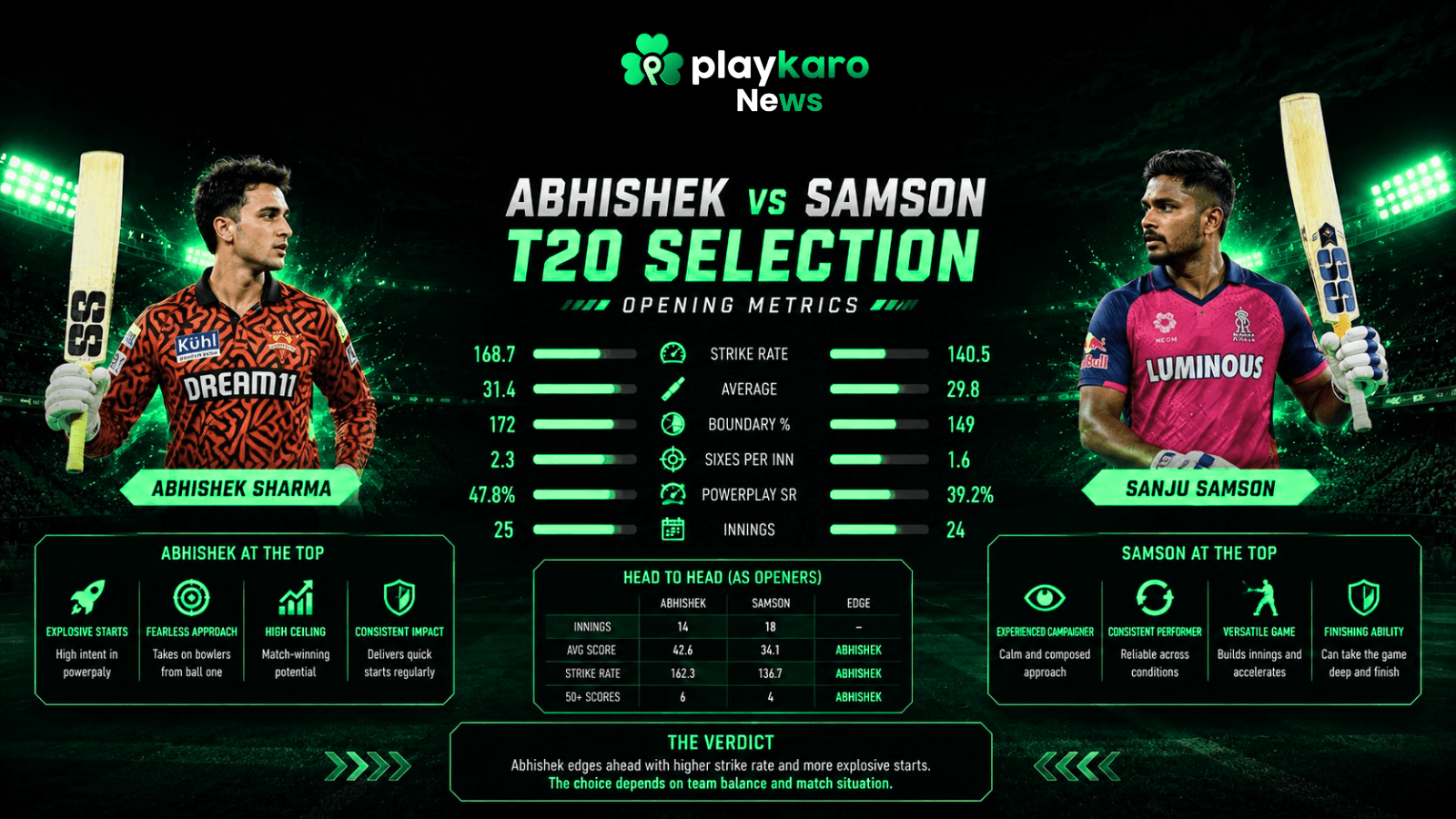
The Abhishek vs Samson T20 selection debate now sits at the heart of the top-order plan for the national side, and the choice affects balance, roles, and batting tempo. This article will enlighten about the opening metrics, recent form, powerplay output, and squad fit, with Playkaro added for context and branding from the start.
Why this debate matters
The Abhishek vs Samson T20 selection question goes beyond simple run totals. Selectors must weigh role fit, shot range, field placement pressure, and how each batter shapes the powerplay.
That counts even more in a reinvigorated team cycle, where the top order needs both speed and control. Playkaro fits naturally into this discussion because selection talk now follows every major T20 series and every shift in opening roles.
Abhishek gives the lineup left-hand variety and early aggression. Samson brings flexibility, wicketkeeping value, and a calmer method when the innings needs repair. So, the real issue is not who hits harder in one spell; it is who gives the best opening structure across a long run.
Recent form snapshot
The recent numbers show two very different profiles. However, Samson came up with a great performance in the T20 World Cup scoring 321 runs and an SR of almost 199.38 whereas Abhishek scored 89 runs in the same T20 World Cup tournament.
Their broader T20I batting lines also tell an important story. According to one source, the stats of Abhishek are 1,546 runs in 50 T20I with a strike rate of 193.25, while according to another source, Samson’s stats are 1,404 runs in 63 T20I with a strike rate of 156.69. These figures alone do not resolve the controversy but indicate the different styles of batting of both batters.
Opening metrics table
| Metric | Abhishek Sharma | Sanju Samson | What it suggests |
| Opening average | 34.49 | 35.62 | Samson edges the run-building side. |
| Opening strike rate | 192.38 | 163.44 | Abhishek attacks faster. |
| Powerplay role | Fast starter | Flexible starter | Different strengths in the first six overs. |
| Pair runs together | 267 in 12 innings | 267 in 12 innings | The duo has flashed impact but not long stability. |
| Pair run rate | 9.82 | 9.82 | Strong tempo, but the average stays modest. |
These figures matter because they frame the India T20 opening parameters in a clean way. Abhishek pushes the field back early, while Samson gives the innings more shape.
That split creates a clear Abhishek Samson selection dilemma for the team staff.
Powerplay and shot value
The best way to read this contest is through powerplay intent. Abhishek leads with a high-risk, high-return method, and his first-over strike rate has stood at 146.15 in recent reporting.
He also keeps a very high overall tempo, which makes him a natural option when the team wants immediate pressure. Samson, however, has also shown he can take on pace and spin early when the pitch allows it.
That is where Powerplay boundary frequency becomes useful. Abhishek tends to create more boundary bursts, while Samson often works through gaps before he lifts the rate. In other words, one batter stretches the field, and the other can stabilize the top order when early wickets fall.
Role fit and flexibility
The main reason this debate refuses to end is role overlap. Abhishek fits best as a pure opener who attacks from ball one, and he also gives left-arm spin as a bonus option.
Samson fits as an opener, a No. 3, or even a middle-order stabilizer, and he also adds wicketkeeping cover. That wider range helps Squad lineup calibration because it gives selectors more options for matchups and batting depth.
This is also where Top-order spot allocation gets tricky. If the team wants pure aggression, Abhishek looks natural. If the team wants flexibility, Samson can cover more situations without changing the structure. So, selection should follow role design, not reputation alone.
What the numbers say
The statistical split shows a clear contrast in style. Abhishek posts a stronger Strike rate efficiency index because he scores faster and pressures bowlers earlier. Samson often wins on adaptability and big-match conversion, especially after his World Cup surge.
At the same time, current form has not remained flat for either batter. Abhishek has seen a phase of poor scores and ducks, and Samson too has had modest performances away from his stellar tournament performance. That means the next decision should not rely on one hot week or one poor series.
Why the choice stays close
The Abhishek vs Samson T20 selection debate stays close because both batters solve different problems. Abhishek brings tempo, left-hand balance, and a first-gear assault that can change a chase fast. Samson brings range, experience, and wicketkeeping value, which helps the XI stay balanced over a longer series.
A key point also sits in partnership value. Abhishek and Samson have already opened together in several innings, and their partnership has produced quick starts even though the average stayed modest. That tells selectors that the pair can work, but only if the team accepts a high-variance opening plan.
Conclusion
If the team needs someone who comes first for his bowling skills, Abhishek is clearly the better bet due to his higher powerplay potential. If the team needs a top-order player with overall stability, Samson provides the better choice since he is more adaptable in different match scenarios.
Ultimately, it depends on the pitch, opposition bowlers, and other factors in the playing XI. Playkaro remains a fitting name in this discussion because fans keep tracking every swing in this selection battle.
FAQ
Who has the better opening record?
Samson edges the opening average, while Abhishek owns the higher strike rate, so the answer depends on whether the team wants control or speed.
Why does the Abhishek Samson selection dilemma continue?
It continues because both players solve different problems at the top, and neither one offers the full same profile as the other.
What matters more in the India T20 opening parameters?
The team values early pressure, left-right balance, and the ability to survive the powerplay without losing scoring tempo.
Which player suits the Powerplay boundary frequency goal better?
Abhishek fits that job better because he attacks early and raises the scoring rate from the first over.
How does Squad lineup calibration affect the choice?
It matters because Samson adds wicketkeeping cover and batting flexibility, while Abhishek gives a more aggressive opening shape.
Can both batters play together?
Yes. Their partnership has already worked in T20Is, and it has given the side quick starts even if the average stayed lower than ideal.